This August 15 (2019), the National Institute for Space Research (Brazil) published satellite photographs in which the magnitude of the forest fires of the Amazon basin can be appreciated. These intentional fires were promoted in order to open space for human activity and today (originally posted on november 2nd 2019) the forest is still on fire, drawing us minute by minute to the "point of no return" in global warming.
Despite the very high risk that this event represents for the future of the planet, the most popular search results for the words "amazon" and "fire" - in almost any search engine online - suggest that netizens are more interested in the latest media player from the e-commerce giant (Amazon.com); than in the environmental apocalypse looming over humanity.
What's going on?
"The economy, stupid!" The slogan of the Clinton campaign in 1992, sums up the harsh and grotesque lesson of sustainability that the 20th century left us: Life certainly depends on the protection of the environment, but also on the exploitation of natural resources!
The "Lung of the Planet" is not sustainable, simply because 50% of the inhabitants of the Amazon region - one of the richest in all sorts of resources in the world - live below the poverty line. Controversial as he might be, Jair Bolsonaro has a point when he says Europe
shouldn't have the right to dictate how Brazilians should use the
resources they have been saving and that the Amazon Forest is not part of the "World Heritage", because it is a significant local sacrifice.
These inequalities are the product of an undue distribution of the burdens and benefits generated by land use planning in a global scale, but we can take a local approach to the problem:
Regulatory plans (POTS) traditionally adopt the recipe of dividing the territory into zones (urban, rural and conservation), but they seldomly consider the economic repercussions that this practice has on the communities: While some owners have the possibility of economically exploiting their lands, others face the cost of protecting the environment without receiving financial compensation for this service.
This also supposes -at least in Costa Rica- a normative conflict, because while urban development regulations tend to territorialize this inequality, Article 50 of it's Constitution obliges the State to stimulate production and "properly distribute wealth to guarantee the right to a healthy and ecologically balanced environment."
Yes, there are subsidies -such as exemption from the payment of real estate tax (Law 7509) - and compensations -such as the payment of environmental services (PSA) of Law 7575- that remunerate the conservation undertaken by the owners of protected areas. But these mechanisms are just a minimal contribution to the maintenance costs of conservation, and do not adequately distribute the burdens and benefits of territorial planning.
Some of them face serious contradictions. Take for example the "Payment for Environmental Services, which heavily depends on the taxation of hydrocarbons, a source of financing that will be unsustainable if the country moves towards de-carbonization.
To equitably distribute the wealth generated by land use and urban planning; and truly guarantee sustainable urban development, it is necessary to understand the relationship between the conservation of ecosystems and city planning, between the right to a healthy environment and the right to city.
Henry Lefebvre - French sociologist and philosopher - formulated this concept in his book "Right to the City" (1968). For the author, the planning of the territory must guarantee to all the people the access to the land, the economy and the urban life of a city; as these are finely interwoven to form the natural habitat of the human being. The right to the city and the right to a healthy and ecologically balanced environment are the two sides of the sustainability coin.
For this reason, article 31 of the Organic Law of the Environment orders the Municipalities to use their urban land intensively. The logic behind this rule is simple: the more dense, mixed and efficient the use of urban areas, the less the city expands into the countryside, facilitating access to urban land and leaving more space for ecosystems.
David Owen, writer of the book “What Cities Can Teach the Countryside About Sustainability” exposes the benefits of compactness, recounting his experience in a sustainable community on the East Coast of the United States:
“… We decided to make our first home a utopian environmental community in New York State. For seven years we lived in austerity situations that various Americans classified as extreme. Our living space measured only 63m2, we did not have a clothes dryer or a car. We did our shopping on foot, and when we needed to travel a greater distance we used public transport. Our electricity bill was close to the dollar a day. This utopian community is called Manhattan ”.
Although the "Big Apple" is not the first image that comes to mind when we envision a sustainable utopia, it is a great example of how a compact, mixed city can keep the city out of the country and significantly expand forested areas and ensure vibrant and enjoyable places to live.


New York is not only famous for its skyscrapers, but also for its vibrant urban life, diversity of shops and its beautiful and wide parks: Prospect, Bryant, Battery, Riverside and Hudson, join Central Park -by Frederick Law Olmsted- and 1938 more parks, which cover 15% of the surface of the city. To these are added other landscaping initiatives such as Scofidio + Renfro's “New York Highline”, an elevated train line that - had been abandoned since the 1980s - became a 2.5-kilometer-long linear aerial park.
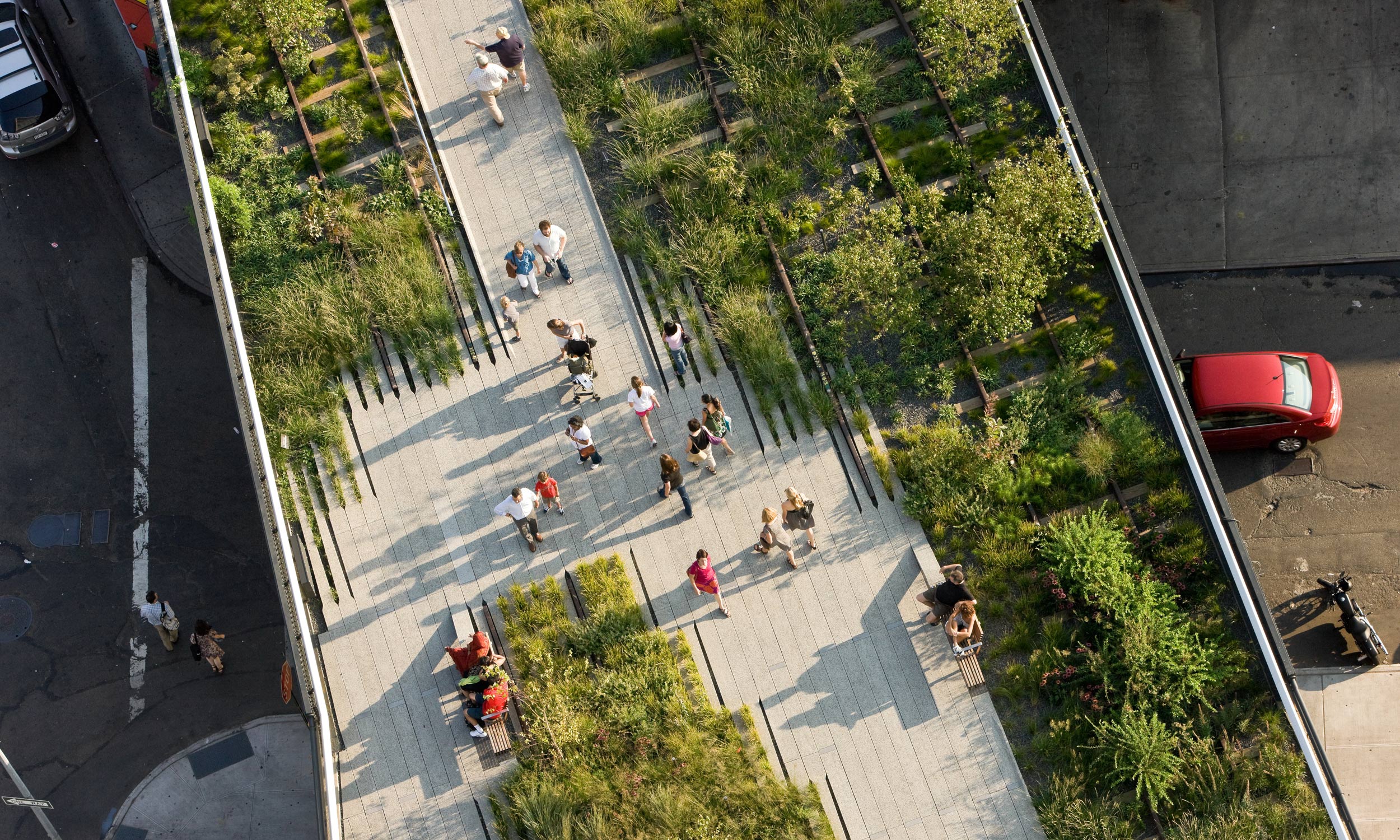
It must be admitted that urban parks - no matter how many there are in the "City that Never Sleeps" - cannot fill the role of a forest like the Amazon. But thanks to its compact strategy, New York also knows "not to build." It is the state with the highest percentage of forested area in the United States, ant the City has funded the acquisition of the Catskill and Adirondack National Parks, the latter - with an area of 24,700 km² - larger than Yellowstone, Yosemite, the Grand Canyon, the Glacier Reserve, and the Great Smoky Mountains combined!
I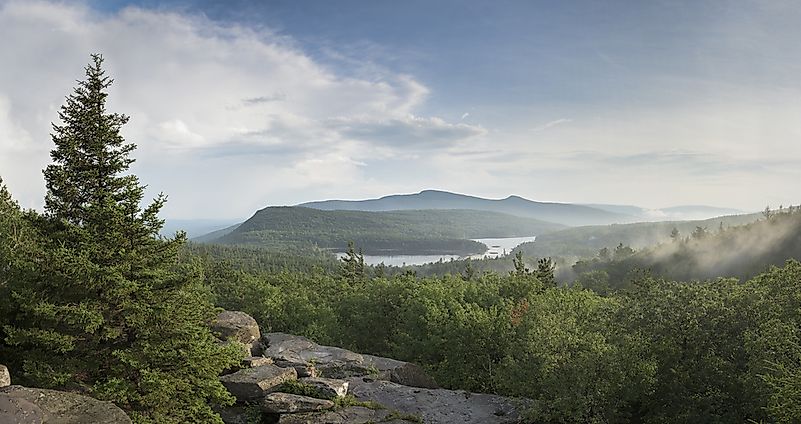
Latin America has several cities of a scale and compactness similar to Manhattan, Santiago, Sao Paulo, Buenos Aires and Mexico are some examples, but these lack the mechanisms to compensate for the protection of their forests, the way New York City and State do.
For this it is necessary to start implementing land management instruments, technical and regulatory mechanisms that allow us to use the capital gains of urban development to finance the protection of our natural environment, without resorting to complex fiscal maneuvers or philanthropy, and we can apply them, despite having a political model different from the city that never sleeps, and in ways that suit a much more human friendly scale.
SOME EXAMPLES:
The transfer of buildable potential is a regulatory instrument that allows strategic real estate operations to buy the “right to build” rather than a rural property of lower value. With this, you can go beyond the construction heights allowed in the Regulatory Plan and expand the buildable area of a project. The transaction offers the owner of the farm that issues the right, a consideration for the environmental service offered, instead of applying an arbitrary charge or limitation.
Building standards (coverage and height) can also encourage projects that give green areas to the city, within a strict economic and ecological logic. It must be remembered that - no matter how necessary - quality green areas have a high cost and real estate developers are not philanthropists. Incentives should be used so that green areas do not compromise the utility of the projects, they should not be a mere symbolic recognition.
NOTICE! Not all green areas are useful in a city.
For instance, it is difficult for the authorities to control the preservation of the residential backyards, so they are usually built over. Backyards, as well as mandatory condo amenities, are seldomly used to full capacity and do not contribute to the city's landscape and perception of well being.
One big improvement in local planning would be making all “mandatory” green areas go to the front -where they can be supervised by the authorities- and outside, where they can be used intensively by the public, making internal green areas an option, not an obligation.

Some municipalities have also chosen to place economic charges on vacant lots. This incentive causes them to be used, keeping the city within its limits, boosting the economy and facilitating access to urban land by reducing prices that speculation tends to inflate.
Let's imagine that the 100 largest cities in Latin America adopted instruments like these to finance the protection of ecosystems. If they could raise $ 1 a month for each of their urban square meters. In 20 years they would be able to purchase and finance the definitive conservation of the Amazon; recognizing a value of $ 2500 per hectare to each owner of wood land.
It is not impossible! By making intensive use of urban land, this goal could be achieved long before 2050 and by the 22nd century we would have turned our cities into true engines of real sustainability. It is no longer trivial, the Amazon is on fire, we are in mortal danger. It's ecology economists! The new business of the 21st century.

No hay comentarios:
Publicar un comentario