Pages

martes, 22 de septiembre de 2020

Its Ecology, Economists!

This August 15 (2019), the National Institute for Space Research (Brazil) published satellite photographs in which the magnitude of the forest fires of the Amazon basin can be appreciated. These intentional fires were promoted in order to open space for human activity and today (originally posted on november 2nd 2019) the forest is still on fire, drawing us minute by minute to the "point of no return" in global warming.

Resultado de imagen para brasil fires satellite view"

Despite the very high risk that this event represents for the future of the planet, the most popular search results for the words "amazon" and "fire" - in almost any search engine online - suggest that netizens are more interested in the latest media player from the e-commerce giant (Amazon.com); than in the environmental apocalypse looming over humanity.

 What's going on?

Resultado de imagen para the economy stupid"


"The economy, stupid!" The slogan of the Clinton campaign in 1992, sums up the harsh and grotesque lesson of sustainability that the 20th century left us: Life certainly depends on the protection of the environment, but also on the exploitation of natural resources!

The "Lung of the Planet" is not sustainable, simply because 50% of the inhabitants of the Amazon region - one of the richest in all sorts of resources in the world - live below the poverty line. Controversial as he might be, Jair Bolsonaro has a point when he says Europe shouldn't have the right to dictate how Brazilians should use the resources they have been saving and that the Amazon Forest is not part of the "World Heritage", because it is a significant local sacrifice.

These inequalities are the product of an undue distribution of the burdens and benefits generated by land use planning in a global scale, but we can take a local approach to the problem:

Regulatory plans (POTS) traditionally adopt the recipe of dividing the territory into zones (urban, rural and conservation), but they seldomly consider the economic repercussions that this practice has on the communities: While some owners have the possibility of economically exploiting their lands, others face the cost of protecting the environment without receiving financial compensation for this service.

This also supposes -at least in Costa Rica- a normative conflict, because while urban development regulations tend to territorialize this inequality, Article 50 of it's Constitution obliges the State to stimulate production and "properly distribute wealth to guarantee the right to a healthy and ecologically balanced environment."

Yes, there are subsidies -such as exemption from the payment of real estate tax (Law 7509) - and compensations -such as the payment of environmental services (PSA) of Law 7575- that remunerate the conservation undertaken by the owners of protected areas. But these mechanisms are just a minimal contribution to the maintenance costs of conservation, and do not adequately distribute the burdens and benefits of territorial planning.

Some of them face serious contradictions. Take for example the "Payment for Environmental Services, which heavily depends on the taxation of hydrocarbons, a source of financing that will be unsustainable if the country moves towards de-carbonization.

To equitably distribute the wealth generated by land use and urban planning; and truly guarantee sustainable urban development, it is necessary to understand the relationship between the conservation of ecosystems and city planning, between the right to a healthy environment and the right to city.

Henry Lefebvre - French sociologist and philosopher - formulated this concept in his book "Right to the City" (1968). For the author, the planning of the territory must guarantee to all the people the access to the land, the economy and the urban life of a city; as these are finely interwoven to form the natural habitat of the human being. The right to the city and the right to a healthy and ecologically balanced environment are the two sides of the sustainability coin.

Resultado de imagen para derecho a la ciudad, henri lefebvre"

For this reason, article 31 of the Organic Law of the Environment orders the Municipalities to use their urban land intensively. The logic behind this rule is simple: the more dense, mixed and efficient the use of urban areas, the less the city expands into the countryside, facilitating access to urban land and leaving more space for ecosystems.

David Owen, writer of the book “What Cities Can Teach the Countryside About Sustainability” exposes the benefits of compactness, recounting his experience in a sustainable community on the East Coast of the United States:

“… We decided to make our first home a utopian environmental community in New York State. For seven years we lived in austerity situations that various Americans classified as extreme. Our living space measured only 63m2, we did not have a clothes dryer or a car. We did our shopping on foot, and when we needed to travel a greater distance we used public transport. Our electricity bill was close to the dollar a day. This utopian community is called Manhattan ”.

Resultado de imagen para new york"

Although the "Big Apple" is not the first image that comes to mind when we envision a sustainable utopia, it is a great example of how a compact, mixed city can keep the city out of the country and significantly expand forested areas and ensure vibrant and enjoyable places to live.

 Resultado de imagen para new york parks"

New York is not only famous for its skyscrapers, but also for its vibrant urban life, diversity of shops and its beautiful and wide parks: Prospect, Bryant, Battery, Riverside and Hudson, join Central Park -by Frederick Law Olmsted- and 1938 more parks, which cover 15% of the surface of the city. To these are added other landscaping initiatives such as Scofidio + Renfro's “New York Highline”, an elevated train line that - had been abandoned since the 1980s - became a 2.5-kilometer-long linear aerial park.


Resultado de imagen para highline"

It must be admitted that urban parks - no matter how many there are in the "City that Never Sleeps" - cannot fill the role of a forest like the Amazon. But thanks to its compact strategy, New York also knows "not to build." It is the state with the highest percentage of forested area in the United States, ant the City has funded the acquisition of the Catskill and Adirondack National Parks, the latter - with an area of ​​24,700 km² - larger than Yellowstone, Yosemite, the Grand Canyon, the Glacier Reserve, and the Great Smoky Mountains combined!

IResultado de imagen para catskill"
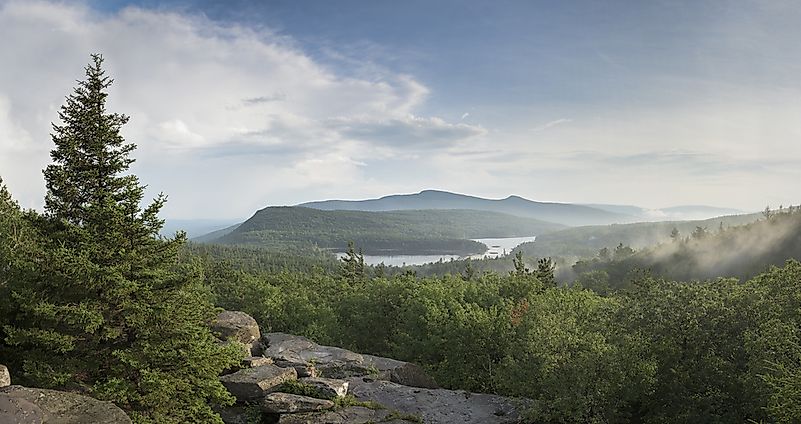
Latin America has several cities of a scale and compactness similar to Manhattan, Santiago, Sao Paulo, Buenos Aires and Mexico are some examples, but these lack the mechanisms to compensate for the protection of their forests, the way New York City and State do.

For this it is necessary to start implementing land management instruments, technical and regulatory mechanisms that allow us to use the capital gains of urban development to finance the protection of our natural environment, without resorting to complex fiscal maneuvers or philanthropy, and we can apply them, despite having a political model different from the city that never sleeps, and in ways that suit a much more human friendly scale.

SOME EXAMPLES:

The transfer of buildable potential is a regulatory instrument that allows strategic real estate operations to buy the “right to build” rather than a rural property of lower value. With this, you can go beyond the construction heights allowed in the Regulatory Plan and expand the buildable area of ​​a project. The transaction offers the owner of the farm that issues the right, a consideration for the environmental service offered, instead of applying an arbitrary charge or limitation.


Building standards (coverage and height) can also encourage projects that give green areas to the city, within a strict economic and ecological logic. It must be remembered that - no matter how necessary - quality green areas have a high cost and real estate developers are not philanthropists. Incentives should be used so that green areas do not compromise the utility of the projects, they should not be a mere symbolic recognition.

NOTICE! Not all green areas are useful in a city.
 

For instance, it is difficult for the authorities to control the preservation of the residential backyards, so they are usually built over. Backyards, as well as mandatory condo amenities, are seldomly used to full capacity and do not contribute to the city's landscape and perception of well being.

One big improvement in local planning would be making all “mandatory” green areas go to the front -where they can be supervised by the authorities- and outside, where they can be used intensively by the public, making internal green areas an option, not an obligation.


Resultado de imagen para Ruta N medellin"


Some municipalities have also chosen to place economic charges on vacant lots. This incentive causes them to be used, keeping the city within its limits, boosting the economy and facilitating access to urban land by reducing prices that speculation tends to inflate.

Let's imagine that the 100 largest cities in Latin America adopted instruments like these to finance the protection of ecosystems. If they could raise $ 1 a month for each of their urban square meters. In 20 years they would be able to purchase and finance the definitive conservation of the Amazon; recognizing a value of $ 2500 per hectare to each owner of wood land.

Resultado de imagen para forest amazon"

It is not impossible! By making intensive use of urban land, this goal could be achieved long before 2050 and by the 22nd century we would have turned our cities into true engines of real sustainability. It is no longer trivial, the Amazon is on fire, we are in mortal danger. It's ecology economists! The new business of the 21st century.

A fractured past, a unified future?

Resultado de imagen para gran área metropolitana de San José"


"I did not see more than one house, which they said was owned by the chief ..." Juan Dávila said of his arrival -with Juan Vazquez de Coronado- to the town of Acserrí, in 1596. Carlos Benavides explains that the explorers found a population " scarce and dispersed within the Central Valley of Costa Rica "with a" diluted character "and a" great proliferation of administrative structures ", which" determined that it was difficult to constitute a strong State, founded on taxes and urban planning, as it happened within Aztec and Inca society. " (Journal of UCR Studies, 1985)

The small population, the settlement based on scattered ranches and the extensive use of natural resources, facilitated the process of subjugation for the Spaniards, who by way of derision, perpetuated the phrase "more caciques than Indians", to refer to the difficulties of coordination between the indigenous people who ended up guaranteeing their defeat.


Four hundred and twenty-four years later, the inhabitants of the Central Valley continue to face great challenges around taxes and urban planning. As we prepare to choose the 186 regidurías that - over the next four years - will dictate the different urban planning measures in the 31 cantons of our Greater Metropolitan Area (GAM), it is prudent to meditate on the daily implications of the geopolitical scheme that we inherited from Pacara , Guarco and Garabito, and if this is congruent with our current reality or should it change.


It is impossible to avoid comparisons with the Huetar people. The GAM has a small population if compared to other Latin American cities, but it is a great (great!) Metropolitan area if analyzed based on its consumption of territory and natural resources; as extensive as Bogotá, São Paulo or Mexico City, but divided between 31 administrative realities and almost 200 decision makers.


Other cities in the region with a similar territorial scale operate more efficiently:

· Bogotá -with its 7.3 million inhabitants- has only 45 regidurías.
· Mexico City (8.5 million inhabitants) has 66 congressmen.
· São Paulo (11.3 million inhabitants) has 55 vereadurías.

On average, large Latin American cities elect 1 representative for every 165,000 inhabitants, while the GAM 1 for every 11,000. The inevitable product of this is well known: trunked infrastructure, congestion as far as the eye can see, hanging rivers, informal settlements out of control, and complex and cumbersome paperwork.

Our “mini-cipalities” have an adequate scale to provide some basic services -such as waste collection, road cleaning or park maintenance- but definitely, sustainable and integral urban planning is too big for them.

Do we need to rethink the administrative division of the territory? Definitively!, but we still have a few tricks up our sleeve. Articles 63 and subsequent articles of our Urban Planning Law (LPU) propose a structure with the potential to unify our city: The San José Metropolitan Area Planning Office (OPAM).

Since 1968 our legislators devised this inter-municipal body attached to the National Institute of Housing and Urbanism. It is made up of technicians from Aqueducts and Sewers, the Costa Rican Electricity Institute, the Municipalities of the Metropolitan Area and the Ministries of Transportation, Education and Health.

The OPAM has a stable and independent source of financing from the Ministry of Finance, thanks to the contribution of 1% of the annual budget of the municipalities of San José, Escazú, Desamparados, Goicoechea, Alajuelita, Coronado, Tibás, Moravia, Montes de Oca, Curridabat and any other neighboring municipality that agrees to provide this service permanently (Art. 62).

The planning products generated by this service - unlike PRUGAM and POTGAM - acquire the force of law (Art. 64) which guarantees their immediate application.
Despite all these facilities, the OPAM has never operated. None of the institutions involved has triggered the constitution of the office, but each one has sought a segregated, dispersed and diluted territorial action, as has been the custom of the inhabitants of this valley, since times without memory.

Can we overcome the urban legacy of our ancestors and reconcile our fractured realities?

Territorialization vs Sectorization: The curious case of the Mystic Bus.


 Foto: Sociedad Raleigh Costa Rica.

Last week it was announced that the mystical bus, a tourist landmark of the Braulio Carrillo National Park, is going to disappear. Not because of the mysticism attributed to it, but as a result of a sectorial, fragmented and inefficient State.

The constant visitation of curious walkers and mountain bikers seems to have caused damage to the National Park and for this reason the National System of Conservation Areas, from an exclusively environmental perspective, has ordered the dismantling of the mysterious "Blue Bird" that, without explanation , appeared one day in the middle of the forest of San Rafael de Heredia.

It may seem like a logical solution for the environment sector, but it is a great loss for tourism, culture and the economy sectors, which did not have the opportunity to present their own solutions to this singular "problem", because our government sector scheme grants rectories to institutions "specialized" in solving specific issues and does not promote interdisciplinary work.

The opposite is a territorial and subsidiary government scheme (close to the territory and its inhabitants), in which all sectors of the administration respond to the same command structure, which allows the different technical offices to contribute to the integral solution of problems . During its planning processes, a territorial government can integrate various sectors to solve the problem of just one. In this case, the environmental office could have had the support of experts in tourism, economics, engineering and other disciplines to provide a comprehensive solution to the problem.

Our municipalities already work in this way, but their scope is still extremely limited, both due to their legal powers and their scale. They do not have the legal power to make or direct all decisions that directly impact their territory, and their territory is too small to make a positive difference. In our country there are so many "mini-cipalities" that their activity is also territorially fragmented, and if each one made all the decisions about their jurisdiction, it would inevitably affect their neighbors.

In fact, this already causes problems and contradictions in the bordering areas, since the differences between the policies and the regulation of urban areas confuse the average citizen and generate inconveniences and unnecessary pressures on the sustainability of the territory.

Montes de Oca, for example, has just declared its San Rafael district "ecological", while La Unión and Goicoechea allow the development of condominiums in this same geographic basin, this confuses the construction sector and generates unnecessary pressure for the new ecological district. Why does this happen?

In Costa Rica, issuing urban planning regulations is the constitutional authority of the 81 Councils of the 81 municipalities of the country. They are advised by their 81 technical offices of territorial planning, which are overseen by the 162 mayors and vice mayors of the country. Each municipality has it’s own autonomous organization scheme.

By law and administrative decree, this discipline is also supervised by four central government institutions: The National Institute of Housing and Urbanism (INVU); The Ministry of Environment and Human Settlements (MIVAH); The Mortgage Bank for Housing (BANHVI), and the Technical Environmental Secretariat (SETENA).

But most of the public works are executed by the administrators of services and infrastructure such as: concessionaires, the National Power and Light Company, the Costa Rican Electricity Institute, the Costa Rican Radiographic, The Institute of Aqueducts and Sewers and the Ministry of Public Transit; who carry out their work plans independently from each other (because of alleged autonomy).

In this scenario, citizen participation remains -tragically- as a symbolic token, because after each of these actors makes their own plans - naturally - there is nothing left to decide.

If we analyze the insides each of each of these administrative structures, we could make a thesis of biblical proportions but for the purpose of this note it will be enough, to understand the complexity of decision-making in a sectorial state, that we analyze only the decision making structure of the 3 main actors in this sector:

INVU: has a board of directors, an executive president, a management and a deputy management, two directors and three deputy directors. The institute is so loaded with administrative positions that its administrative budget is higher than the budget for the urban planning unit:


BANVHI also has a Board of Directors and a General Manager.

MIVAH has a Minister, a Deputy Minister and three Directors.

(Each with his or her own confidential paid advisers.)

In Europe, despite retaining some administrative autonomy, the small historic municipalities were grouped under the aegis of regional governments. The regions plan the territory, address these problems, and order the municipalities, concessionaires and service providers to address the problems of the population according to the development plans of each region.

The unification of these institutions in a regional structure could be the solution to reduce costs to the State and promote efficient investments. May the reader consider only the Housing and Human Settlements Sector as an example:

Instead of this, a regional structure would merge the 162 mayoral and vice-mayor positions, with their 81 territorial planning offices, to constitute 6 or 7 administrative regions, each with its own subsidiary headquarters, for example: Ciudad Quesada ( North Zone), San Isidro de Pérez Zeledón (South Zone), Puntarenas (Central Pacific), Liberia (North Pacific), San José (Central Region) and Guápiles (Caribbean Region), each with its Council, its Governor and its office territorial planning.

The regions could assume many of the responsibilities that the Executive currently has, allowing it to decrease significantly, allowing the regions to compete in freeing us from tax burdens.


The municipalities that exist today could become efficient service operators, receiving political direction from the regional government and executing their plans under the supervision of administrative career managers, instead of mayors who may not have the necessary training or experience to be a territorial administrator.

From experience, it can be affirmed that the due coordination that must exist between public entities is illusory in such a sectorial and fragmented scheme and that possibly, if we continue like this, we will have many more taxes and many fewer mystical territories.